

A short introduction to Homomorphic Encryption (Part 1/2)
Jacob Borch Madsen
Software Craftsman - Resident 20. January 2026 Graduates
In an age where data-driven insights power everything from healthcare analytics to financial risk assessments, protecting sensitive information is paramount. Traditional encryption techniques excel at safeguarding data at rest and in transit, but once that data must be in use, it needs to be decrypted, exposing it to potential leaks or misuse.
Homomorphic Encryption (HE) offers a powerful alternative: it allows computations to be performed directly on encrypted data, producing encrypted results that, when decrypted, match what would have been obtained, had the computations been performed on the plaintext. In this article we will explore a high level overview of What HE is, why it’s useful and what challenges it faces.
1. What Is Homomorphic Encryption?
At its core, encryption transforms readable data (plaintext) into an unreadable format (ciphertext) using a secret key. Only someone with that key can reverse the process and access the original information. In standard encryption schemes, any operation on the ciphertext, such as addition or multiplication, will make the result into junk. The underlying structure of the original values will be lost. As a consequence, in order to perform computations on encrypted data, every party involved must possess the secret key, broadening the circle of trust and increasing exposure to security risks.
Homomorphic Encryption provides an alternative to this. A homomorphic encryption algorithm can preserve the underlying structure, while performing operations on encrypted data.
In other words, you can apply a function f to ciphertexts, and after decryption, obtain exactly the same outcome as if you had applied f to the original plaintexts. Crucially, the party performing these operations never needs to see the secret key or the raw data.
Encryption States
-
At Rest: Data stored on disk or in databases.
-
In Transit: Data moving across networks.
-
In Use: Data loaded into memory for computation.
While conventional encryption protects data at rest and in transit, it must be decrypted for computation, leaving a vulnerability window while the data is in use. Homomorphic encryption extends this, enabling secure “in-use” processing.
2. Why is homomorphic encryption useful?
By allowing encrypted computations without exposing raw data or secret keys, HE unlocks new capabilities for privacy and data protection:
-
Minimized Trust Surface
With conventional encryption, every computational party must be trusted with your key. Homomorphic schemes let you restrict key access to only those who need the final data, reducing the risk of third-party breaches. -
Enhanced Security Posture
Even if a service provider’s infrastructure is compromised, attackers encounter only ciphertext, which are essentially useless without the secret key. This removes a major attack vector when offloading work to external compute environments, such as cloud environments. -
Post-Quantum Resilience
Many HE algorithms rely on lattice-based or Ring-Learning With Errors (Ring-LWE) problems, which are currently believed to be quantum proof. Unlike RSA or ECC, which are prone to quantum computer attacks (like Shor’s algorithm), homomorphic schemes promise long-term security.

Real-World Scenario: Healthcare Analytics
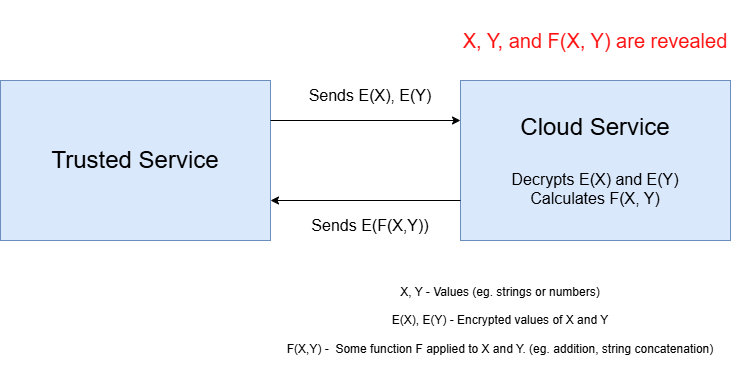
Imagine a hospital looking to leverage cloud resources for large-scale patient analytics. Their goal could be identifying trends in patient visits, optimizing staff level, or training predictive models on sensitive patient data. Under a traditional model (see figure 1.1) it would roughly look like this:
-
Data Upload
The hospital encrypts patient records and uploads them to the cloud. -
Key Sharing
To run computations, the cloud service needs the decryption key. -
Processing
The cloud decrypts, processes data, then re-encrypts results.
With homomorphic encryption:
-
Data Upload
Patient records are encrypted under the hospital’s key and sent to the cloud. -
Computation on Ciphertext
The cloud performs analytics directly on the encrypted data. -
Result Retrieval
Encrypted results are sent back; only the hospital (key-holder) can decrypt and view insights.
This architecture ensures zero trust in the cloud provider, while utilizing their massive infrastructure and compute power.
3. Limitations of Homomorphic Encryption
Despite its promise, HE faces practical problems that have limited the current adoption:
3.1 Performance Overhead
-
High CPU Usage: Each encrypted operation can be orders of magnitude slower than its plaintext counterpart.
-
Memory Footprint: Ciphertexts are significantly larger than plaintexts, increasing storage and bandwidth requirements.
3.2 Algorithmic Complexity
HE-friendly operations (e.g., addition, multiplication) are relatively efficient, but branching, comparisons, and conditional logic often require workarounds, such as encoding logic as polynomial approximations.
Noise growth can be thought of as a budget in homomorphic encryption. Each time an operation is done on homomorphically encrypted data, it adds a little bit of noise. If the amount of generated noise becomes too big (exceeds some budget/threshold), the data will become invalid.
3.3 Developer and Implementation Challenges
Getting optimal performance and correct results, involves balancing noise growth in ciphertexts, choosing appropriate parameter sets, and structuring computations to minimize expensive operations. All demanding expertise in cryptography.
4. The Road Ahead
Despite the practical challenges, solutions and improvements are continually being made:
4.1 Hardware Acceleration: HE-Dedicated Chips
Researchers and organizations, including DARPA-funded teams, are exploring specialized processors that implement homomorphic primitives directly into the chip. Experiments show speedups of 10× to 1,000× over pure-software approaches, making HE more viable for real-time or large-scale workloads.
4.2 Evolving Software Ecosystem
A growing suite of open-source libraries abstracts away much of the underlying cryptographic complexities, lowering the barrier of entry for developers. Notable libraries include:
-
Microsoft SEAL (C#, C++)
-
PALISADE (C++, with Python bindings)
-
HElib (C++)
-
Lattigo (Go)
While these toolkits cannot eliminate all HE complexities, they standardize core operations such as: parameter selection, key management, ciphertext packing, so developers can focus on application logic rather than cryptographic details.
5. Conclusion
Homomorphic Encryption represents a paradigm shift in secure data processing, enabling powerful “in-use” protection without sacrificing computational capabilities. Just as the recent surge in machine-learning breakthroughs was driven largely by big improvements in GPU and accelerator hardware, HE stands to benefit from specialized chips and architectures that can close its performance gap. Although complexity challenges remain, hardware innovation and maturing software libraries is steadily moving homomorphic encryption from theory into production. As data-privacy concerns continue to grow, HE has the potential to become a cornerstone of future-proof, trust-minimized architectures. In part 2 we will explore how to use Microsoft’s SEAL library, to make a minimal C# example program utilizing HE.